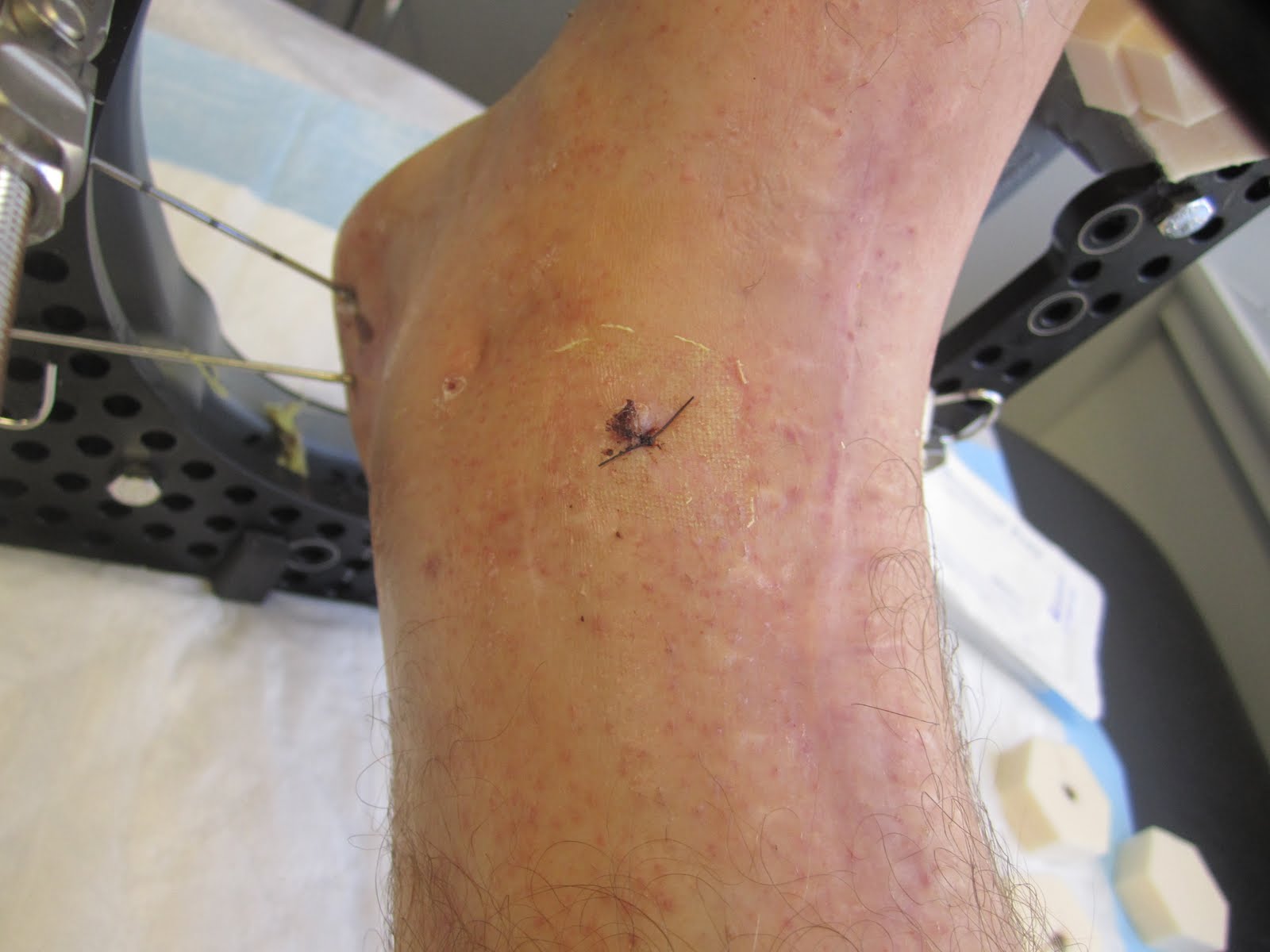
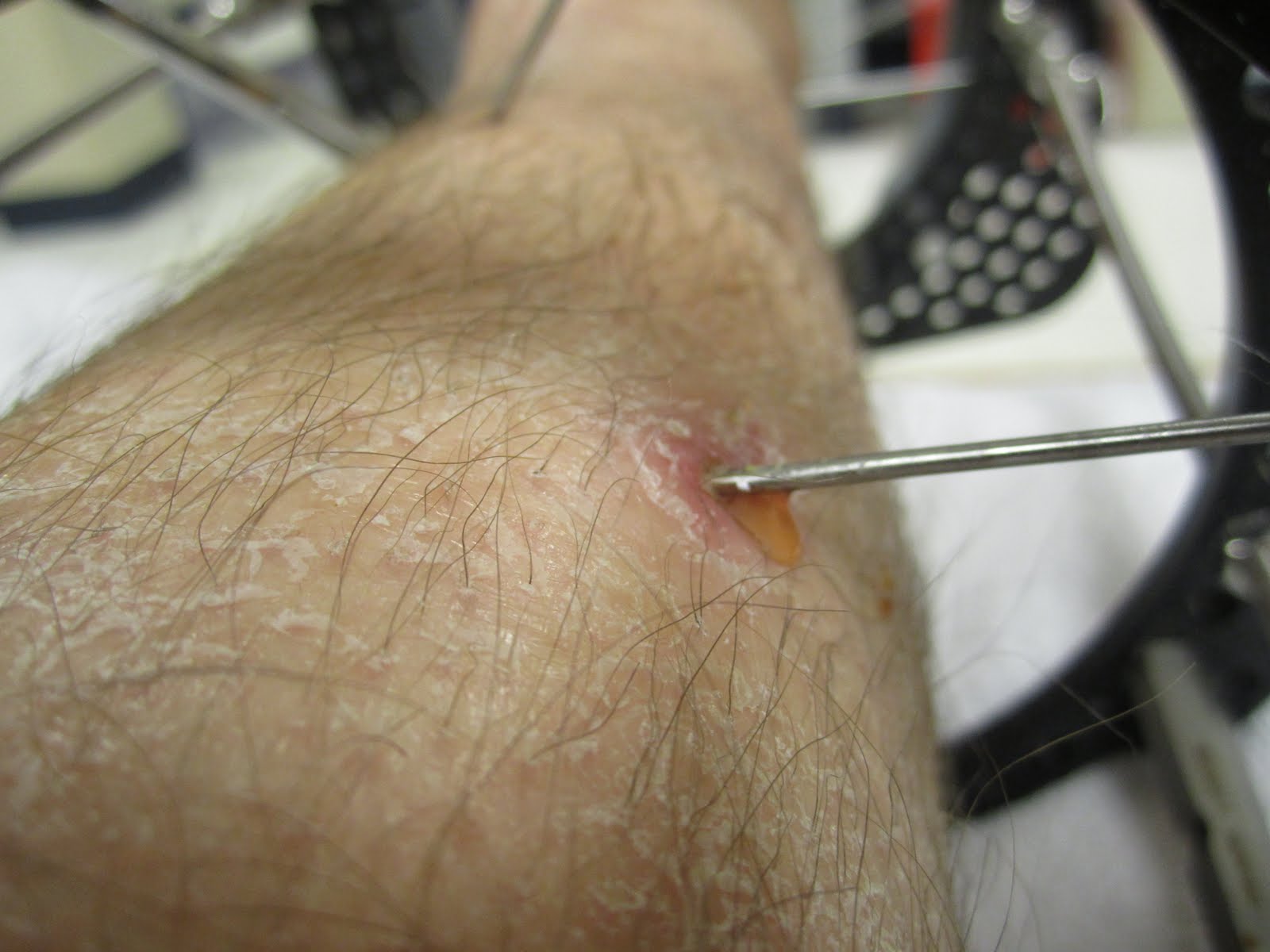
The leg has healed enough to finally take my first shower without my right leg hanging out of the tub since August 15th. While I was pumped to finally get this leg washed, there were some unfortunate consequences.
When I had my accident, my tibial nerve was severely damaged. I lost all of the feeling in my toes, the bottom of my foot, and the medial side of my ankle. After about eight months, the feeling returned. But in the first few weeks of my accident, the neuropathy was terrible. It felt like an electric shock in the toes and the bottom of my foot would feel like it was on fire.
Dr. Jeng warned me that distraction arthroplasty could re-injure the nerve. It did -- I lost feeling in my heel and some parts of the bottom of my foot.
Feeling has come back, but it's still partially numb. I suspect the shower removed a ton of dead skin and exposed some sensitive new skin on the bottom of my foot. As the nerves heal, sensations like a breeze or touch register as pain. It's awesome. And I imagine it's a million times worse than this when you get an amputation.
There are a number of ways to treat neuropathy, but from what I understand, most of the treatments don't stop the pain.
I think our best option is to desensitize the skin on the foot using things like capsaicin and a tennis ball. There's not much else you can do but grin and bear it.
Before my surgery, I tried wearing my boot to see if it would help my arthritis. At the time, it was extremely painful to get in the boot, extremely painful to wear it, and even more painful when I got out of the boot.
Since last Thursday, I have not experienced pain like that, which is great. I don't feel or hear grinding noises (yet) from my ankle. These are all good signs.
Unfortunately, having undergone this type of recovery and physical therapy twice before in the last two years does not make the third time any easier. It definitely hurts. Tendons, ligaments, everything has atrophied, contracted, and stiffened up. However, reading what I was going through this time last year helps put things into perspective.
So far, I don't think I've felt any arthritic pain. I'm taking Celebrex daily, which makes it easier to cope with the process of waking up my foot and ankle.
I have, however, felt some spots in my ankle, particularly on the anterior lateral side, that might end up becoming arthritic sites. This is the area of my ankle I had the most pain before the surgery. Dr. Jeng specifically removed bone spurs in that area of my ankle to address it.
I'm still holding out judgement until after I finish physical therapy. We see Dr. Jeng next Friday to get x-rays.
Here's what my ankle looked like in December 2010, a few weeks into physical therapy. You can see that there isn't much joint space left. I'm hoping we see some improved joint space next week. The flouroscopic images from last week's surgery looked promising -- but I'm afraid I was too optimistic (and drugged) when I created the "enhanced" image to help show the new space.
I'll keep you guys updated. This is the part of the recovery that blows.
A friend of mine complained that there weren't enough gross pictures on my blog.
My leg has not been washed since August 15th, 2011. Take a big whiff. Be careful, though. Even over the Internet, the stench can make you faint.
Dr. Jeng, if you're reading this blog post, don't get mad at me. My dressing was making it difficult to wear my boot comfortably, so tonight I decided to change it tonight.
I took advantage of the opportunity to capture my current ankle flexibility and compare it against what it was a year ago -- a few days after getting out of my second external fixator.
November 6th, 2011
November 15th, 2010
It looks like in about one year, I've gained a little bit more range of motion.
Also, speaking of Groundhog Day, both of these videos, taken one year apart, have an NFL football game going on in the background.
Someone suggested I turn my ex-fix into a lamp. I'm not sure my wife would like that.
Actually, I'm sure.
I had forgotten how much this thing weighs. It's about five pounds.
The ankle is feeling great. I'm experiencing the normal soreness and stiffness pains that twelve weeks of immobility will inevitably cause. I've been using a half-foam roll and a wobble board to help me work out the stiffness while I wait for the wounds to heal. Once they heal, I can start up physical therapy.
When I'm up and moving around at work, I'm back in a boot to provide stability.
While we're excited to see how much joint space we've acquired with distraction arthroplasty, I'm holding out judgement for about twelve more weeks. The articular surface of my tibia is like a meat tenderizer. Walking and moving the ankle will likely wear down the new tissue we've grown -- it's only a matter of time.
But that's the key question -- how much time have we bought ourselves before symptoms show up again? The research shows about five years, but the procedure is still relatively new. As a result, data on long-term outcomes is not readily available.
All things considered, it's amazing to see how far we've come.
From the initial injury above, to this, roughly two years later:
Mom. Before you watch this video, maybe you should get Dad in the room to keep you calm. The beeping noises you hear are all normal. I'm safe and everything went as planned.
Here's the 22 minute video of this morning's operation. I apologize for the quality, but my camera only allows me to capture approximately 10 minutes of HD video. While this video is not as exciting as last year's cowboy ex-fix removal video, I think this video is more interesting and realistic for other patients undergoing a similar procedure.
Most people should be asleep for this procedure, particularly if the half screws are removed by hand instead of a drill from your surgeon's garage.
I had a local nerve block for this procedure, but it was not as intense as the August block. When I woke up, I could feel my foot and leg. As the block continues to wear off since this morning, I'm starting to feel more pain in the ankle joint -- particularly the posterior medial side of the joint.
I'd encourage you to continue taking Oxycontin and Oxycodone for a few days after this procedure, but plan on switching over to something like Celebrex soon. I intend on easing off of both Oxycontin and Oxycodone this weekend, using Valium to help deal with the withdraw symptoms associated with discontinued use of these drugs.
Back to the video -- you probably noticed my awesome operating room nurse struck a pose after cleaning my pin sites in the beginning. Another interesting moment was seeing how securely the two half screws were embedded in my tibia. Particularly the distal screw -- Dr. Jeng had to bring in some elbow grease to get that one going.
Now on to some pictures taken before the procedure.
As you can see, I stuck with the plan to wear my sweet silver breakaways.
This is, hopefully, the last time you'll see an external fixator on my right leg.
The proximal pin site on the lateral side was continuing to leak normal edema fluid. This is not a sign of infection.
The second-most proximal pin site had scabbed up since yesterday, looking much better.
The lateral pin sites in my fore foot were leaking fluid yesterday, but today they seemed fine.
So, after twelve weeks of ankle distraction, what were the results? Here's where we started -- pay attention to the lack of space in my ankle joint.
There's no joint space here in this X-Ray taken in June 2011. Now look at the flouroscopy images taken during today's surgery.
What's this I see? I have joint space!!!!!! Hard to tell? Take a look at this enhanced image.
I was blown away when I saw how much joint space I now have. Keep in mind that I have not been weight bearing on the new joint -- this is still only a few hours old -- but compare this joint space to the absolute lack of joint space I had in the June X-Ray above. In June, my ankle was in a bone-on-bone contact situation, making the subchondral bone at the surfaces of the tibia and talus too dense. When the bone becomes dense, it does not readily absorb the impact shock of walking as less dense bone. Moreover, as joint space narrows, the synovial lining around the joint becomes inflamed and painful -- this is called synovitis. It hurts.
During the first weeks of this procedure, especially after seeing the arthroscopic images, my hopes were not high. Neither were Dr. Jeng's. He managed our expectations and let us know that my ankle was in terrible shape. There wasn't much cartilage to work with.
But now my hopes are a bit higher. In one of the research papers I read last month (I'm still working on that post!), it's not just new cartilage growth and repair that helps increase the joint space after ankle distraction arthroplasty. In fact, it is very challenging to regrow cartilage. What we're finding out is other tissues grow in the joint space and act like cartilage. Here's a very interesting quote from the 2002 paper, "Joint distraction as an alternative for the treatment of osteoarthritis:"
We have to keep in mind, however, that the observed clinical benefit might not be dependent on cartilage repair, bony changes, and cartilage–bone interactions alone, but may have many different origins. For example, stretching the nerve endings during treatment, or a diminished synovial inflammation after treatmentmay relieve pain. Also, the formation of fibrous tissue could explain the increase in joint space width. Because the fibrous tissue is a soft tissue, it may change load transfer in the joint. This could absorb stress during joint loading and by this mechanism diminish pain directly, or indirectly by way of secondary changes in subchondral sclerosis.
I think it's safe to say this research might be confirmed with my results so far. I had essentially no cartilage left in my ankle, but after distraction for twelve weeks, I've got significant joint space widening.
We'll continue to monitor the pain and joint space as I start easing into walking again. Stay tuned!
I made a promise to never wear breakaway pants ever again after last Friday.
But then I found these bad boys. Sweet silver breakaways that my parents bought me back in August. Even our dog, Spunky, is wondering why I choose to look like an idiot.
This stance may look stupid to you, but as most people with external fixators know, this is the stance you make in pictures the night before a surgery. Standard operating procedure, folks.